Showing posts with label Singer Sewing Machine. Show all posts

Thursday, 6 September 2012

Patchwork


Sat in my sewing corner for the last ten months has been one 1948 Kenmore 95 Rotary sewing machine. The Sears cabinet suffered a hinge death on it's move into the apartment and without any instructions we had trouble not only finding a replacement but knowing how to thread the machine. But a crafty girl breaks sometimes, when there's a machine that she can't use. A failed attempt at buying a replacement hinge and feeling the need to use my fabric goodness lead me to a tearful angry moment of threatening to throw the machine out. Said anger lead me to reconstructing the sewing machine table [you can see how it looks within it's cabinet look here] to make it usable and with a copy of the original instructions I was ready. I had no purpose or method to my sewing. I just needed to sew. Anything. It turned out I created a cushion for my sewing chair. It's rough, it's a little uneven but to me that's beside the point. It was just something I needed to do. 

Sewing anger lead to finally see past the broken hinge and I'm going to use my machine regardless. A broken hinge will not stop me any longer and hopefully my sewing adventures will continue. She's a jolly good machine too, granted not as visually pretty as my 1934 Singer with it's engraved flowers and the like - she's industrial, well built and certainly of her time. But, man can she sew. Actually goes fast enough that the thread breaks. The fact that it can only really go forward and backwards is welcoming to me - less ways to get confused and weirdly enough is powered not by a foot control, but a knee one. 

Speaking of old sewing machines ...


I think remembering I had to leave this sewing machine back in the UK was adding to my hinge anger. Sadly I wonder if this old gal will be able to ever move - being cast iron she certainly isn't the lightest of objects [I can barely carry it]. Additionally I doubt I'd use her in the US as she'd need another power change - she's already 78 years old and been adjusted from a treadle to electric. Maybe once we're flush with money I'll get her here as a display piece.

Do you have an old sewing machine? I'd love to hear all about it!
Tuesday, 22 September 2009

Singer song of pictures

I feel like I haven't posted any of my picture posts for a while, everything has been all crazy and up in the air that I haven't really had chance to search yet alone post any pictures. So many ideas and so little time. Yet I found this post half started in draft form so maybe not is the time to finish it off and make it somewhat publishable.

I've been messing around making strip after strip of patchwork for my cushion covers made from all sorts of materials and colours, and since I'm keeping the 1934 Singer Machine alive and well in full working order, I might as well use this as the basis for completing this post.

When thinking of the Great War thoughts are often turned to the allied forces, in turn this image captures German ladies stood and sitting, working behind their sewing machines in the German Wittenburg Singer factor in 1917-18. The skills of these women were employed to produce uniforms and armaments. Singer machines often came to visually represent the strength and power of the war time effort, with images often showcasing British women sewing in the same frame as the armed forces, the sewer and the Singer the force behind the war.

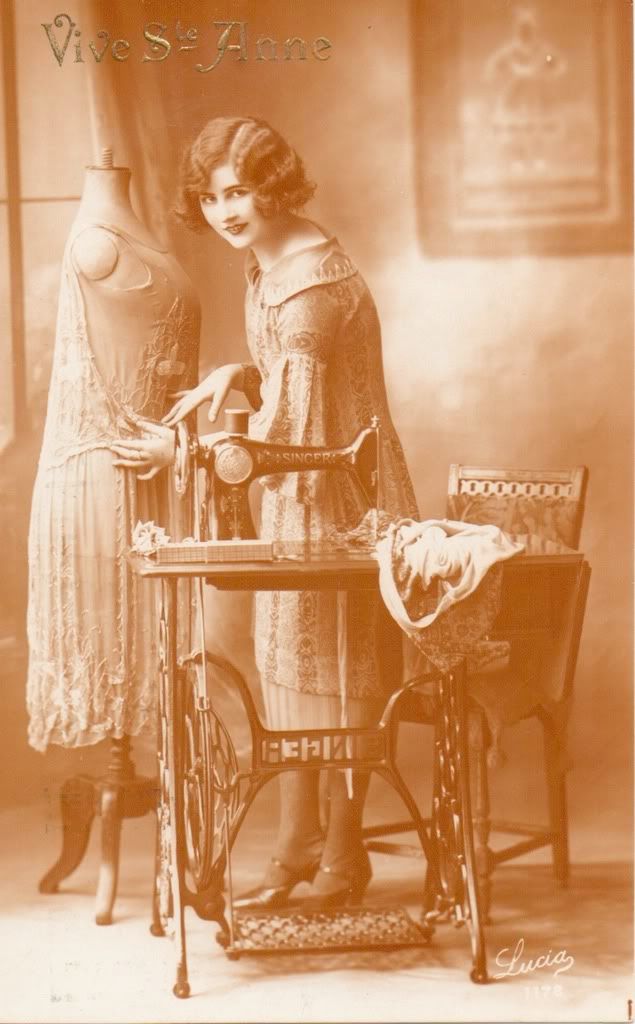
This 1924 postcard from Belgium is one I truly adore, the framing and the atmosphere of capturing this young lady holding together her sewing. The room in which she stands is bare apart from her most important pieces - her sewing machine, a small wooden chair and dressers mannequin. Her lipstick and curls radiate from the image as she holds our gaze, her beauty equals the delicacy of the dress she appears to be holding in place with further material draping over the edge of the desk of her Singer.

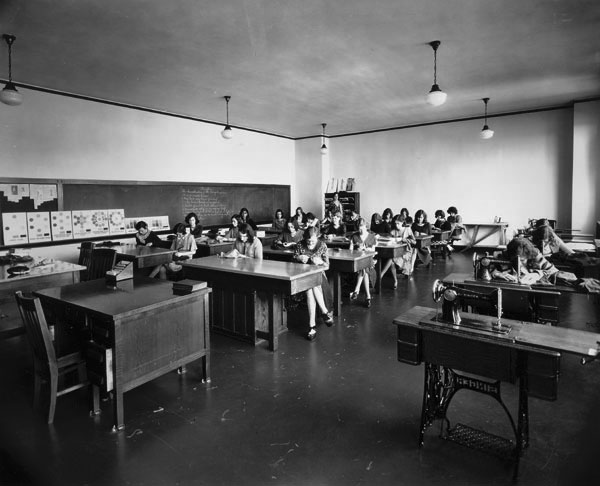
The Wichita High School North home economics sewing class is captured in mid action. Surrounding the room are blackboards describing according to its accompanying captions sewing complementary colours and characteristics of bungalow architecture. Circa 1930 these young women sit eagerly working, leaning behind their desks, the treadle run singer sewing machines and sitting in their desks. 70 years later when I was at high school home economics was poorly taught, and to have a sewing machine for teach pupil was unknown, a few generations later the lost art of sewing and using a machine has more then sadly died especially in the throw-away society with the ease of replacing clothes and items so easily.

Saturday, 12 September 2009

VINTAGE: Singer Adverts

Through inheriting my Singer Sewing Machine (see previous post) I thought I'd use it as the main inspiration for searching around the internet (via the good old google search) to look for anything random to do with singer machines, then I stumbled upon the following advertisements;


1936 black and white advisement for a "modern" electric machine, one allowing the modern women the perfect way to make her own wardrobe.

1959 and the introduction of the family into the frame alongside the advertisements for portable sewing machines, especially designed to aid the function and needs of young and growing families.

Friday, 11 September 2009

VINTAGE: Singer Sewing Machine

Growing up, this old sewing machine lived in the bottom of my Gran's wardrobe. Hidden under empty bags and scarf's this Singer sewing machine rarely saw the light of day the older my gran got. When it did come out from the deepthest depths, we use to work together on her kitchen table, sewing curtains or taking up hems. With my Gran's death (I blogged about her illness the other week - saddly things took a turn for the worse) the machine has now passed into my hands, while I remember the golden drawings on the machines side the silver engraving on the face plate, I've always remembered this as a beautiful working machine.

With a few alterations from my grandad expanding the box upon which the plate box is embedded, its sunken little holder comes with two working and original bobbins and bobbin case and replacement needles, yet its case if it ever had one is long since missing. With a quick dust and a bit of oil in the right places, its near enough looking and most importantly running, like new. Once converted from its original treadle workings, its now electronically powered although the balance wheel needs a spin every now and again to get it turning.

Starting in 1851, the Singer Manufacturing Company (this name is painted in gold paint upon the top of my machine) was launched in New York following the patent of Singer's first locksmith machine. By 1890, Singer could claim to be holding an 80% share of all global sewing machine sales, employing thousands of workers. Using it's serial number embedded upon a small plate upon the box plate a good search on the Singer Company's website reveals this machine to be part of the Y-Series produced at the Kilbowie factory, Scotland in 1934.

For an old girl reaching her 75th birthday this year, she still sews like a dream, her plating still engraved and shining. While she may only have one stitch and one speed I'm proud to be her new owner. And she will be used, rather then hiding her away in the loft or sitting her aside to gather dust, she will be a working machine and an object of beauty, with a task in hand already of patchwork cushion covers.

Also as a weird coincidence one of my mams old books hidden away in the bookcase is the Big Book of Needlecraft published only a year after my Singer rolled off the production line. Now they have to be kept together, they complement each other, the book narrating the change from treadle to electric, naming the machines key parts, its oiling points and common sewing mishaps.

All ideas of anything else to sew are always welcome ...